
Here we will show you how to count by 1850, discuss counting by 1850 patterns, and tell you why knowing how to count by 1850 matters. To start off, note that Count by 1850 means counting in 1850s, or count by one thousand eight hundred fifties, and it is also called skip counting by 1850.
How to count by 1850
Normally, we would count by 1 like this: 1, 2, 3, 4, etc., but when we count by 1850, we count 1850, 3700, 5550, 7400, and so on.
In other words, to count in intervals of 1850 or skip counting by 1850, we start with 1850 and then add 1850 to get the next number, and then continue adding 1850 to the previous number to keep counting by 1850, like this:
1850
1850 + 1850 = 3700
3700 + 1850 = 5550
5550 + 1850 = 7400
7400 + 1850 = 9250
...
You can of course skip count by 1850 forever, so it is impossible to make a list of all numbers, but below is a Count by 1850 Chart of the first 100 numbers to get you started.
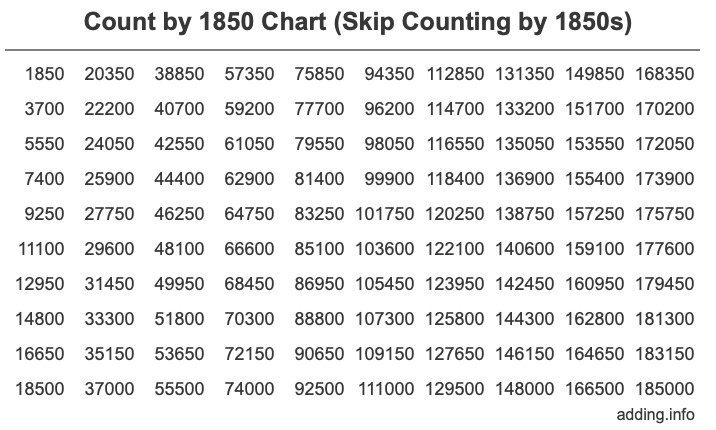
Looking at the chart above, you will see that the first column has the first ten numbers you get when you skip count by 1850, the second column has the next ten numbers you get when you skip count by 1850, and so forth.
Count by 1850 Patterns
We organized the Skip Counting by 1850s Chart above in 10 rows and 10 columns so you can easily identify patterns.
Skip counting always creates patterns. Figuring out these patterns may help you if want to count by 1850, but don't have the Counting by 1850s Chart above. Obviously, one pattern with counting by 1850s is that the number increases by 1850.
Furthermore, if you look at each row above, each number in the row has the same last digit (ones place). That means that every tenth number has the same last digit.
If you look down the columns, you will see that the last digit (ones place) repeats itself in blocks of 1 over and over. The pattern of the last digit when you count by 1850 goes 0 and 0 and so on for as long as you count by 1850.
Why Count by 1850?
We think that understanding and learning about skip counting by 1850 is important, because it teaches you how the arithmetic operations fit together. Below are some examples of what we mean.
When you count by one thousand eight hundred fifty, you are also creating a list of multiples of 1850 that you can use in math when you need the least common multiple. 1850 times n equals the nth multiple or skip count of 1850.
When you skip count by 1850, you are also creating a list of numbers that 1850 is divisible by. On top of that, skip counting by 1850 is the same as making the 1850 times table.
Skip Counting
Need to skip count by another number? Enter another number for us to skip count for you.
Count by 1851
Here is the next number on our list that we used to skip count.
Copyright | Privacy Policy | Disclaimer | Contact